Introduction
Understanding dental insurance is the first step toward getting the most out of your oral‑health benefits. A typical plan includes a premium, a deductible, co‑payments or coinsurance, an annual maximum, and sometimes waiting periods for major work. Knowing how each piece works lets you plan cleanings, fillings, crowns and orthodontic care with confidence, especially in a community like Somerville where many families rely on employer‑provided or Marketplace plans. This guide walks you through the key components, explains how preventive visits are covered at 100 % and why timing major procedures matters, and offers practical tips—such as using in‑network dentists, leveraging FSAs/HSAs, and tracking your remaining benefit—to help Somerville residents maximize coverage, avoid surprise costs, and keep smiles healthy year after year.
Understanding Your Dental Benefits Overview
Key Elements of a Dental Benefits Summary
| Component | Description | Typical Value |
|---|---|---|
| Deductible | Amount you must pay before the insurer shares costs. | $0 – $100 per year (e.g., $50) |
| Co‑insurance | Percentage of the allowed fee the plan pays after deductible. | 80 % for basic, 50 % for major |
| Annual Maximum | Cap on the total amount the insurer will pay each calendar year. | $1,000 – $1,500 (sometimes up to $2,000) |
| Preventive Coverage | Services usually exempt from deductible and covered at 100 %. | Cleanings, exams, X‑rays, fluoride |
| Premium | Cost you pay (usually monthly or annually) for the coverage. | ~$600 per year for individual plans |
| Waiting Period | Time before certain services become payable. | Often none for preventive; 6–12 months for major |
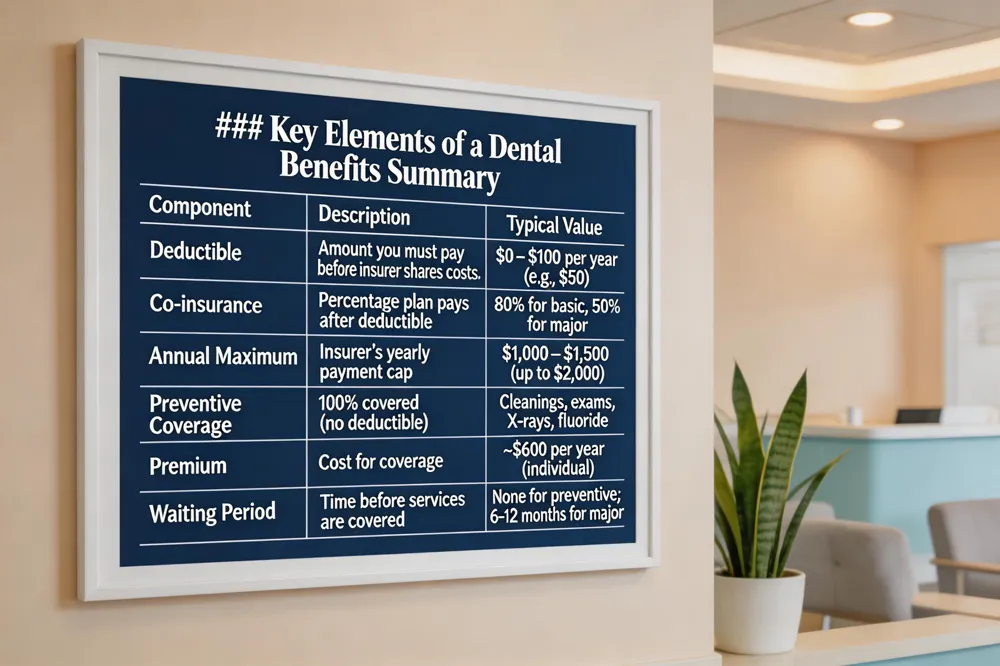 Reading the dental‑insurance PDF gives you a clear, printable snapshot of your plan – deductibles, co‑insurance percentages, annual maximum (often $1,000‑$1,500), and which services fall into preventive, basic, or major categories. Knowing these details lets you ask the office to verify benefits before an appointment and avoid surprise charges. A deductible is the amount you must pay each year before the insurer shares costs; for example, a $50 deductible applied to a $250 filling means you pay $50 up‑front, then the plan covers 80 % of the remaining $200. Preventive care (cleanings, exams, X‑rays) is usually exempt from the deductible and is 100 % covered when you see an in‑network dentist. The overall benefit of dental insurance is lower out‑of‑pocket costs for routine and restorative work, negotiated fee discounts, and protection against expensive emergencies. A $600 annual premium is typical for individual coverage and is cost‑effective if you expect any major procedures such as crowns, bridges, or root canals, especially when you maximize preventive visits and stay within your annual maximum.
Preventive Care and Early Detection
Preventive Care Benefits
| Service | Coverage % | Deductible | Waiting Period |
|---|---|---|---|
| Cleanings (twice‑yearly) | 100 % | None | None |
| Oral Exams | 100 % | None | None |
| X‑rays | 100 % | None | None |
| Fluoride Treatment | 100 % | None | None |
| Periodontal Screening | 100 % | None | None |
Most plans waive the waiting period for these services, allowing immediate use after enrollment.
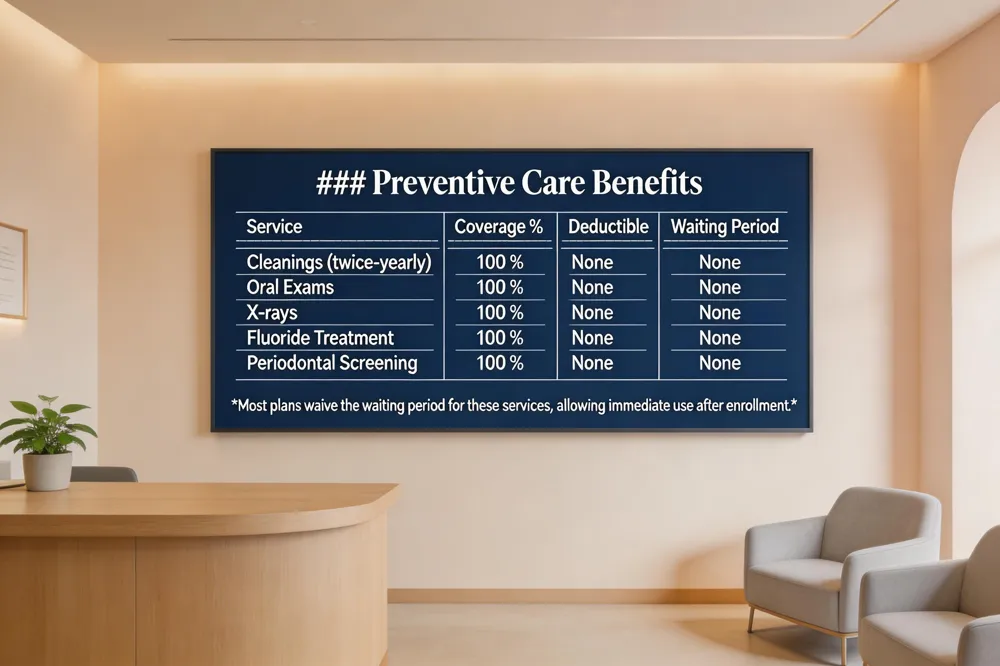 Dental insurance for adults is built around a 100 % coverage of preventive services—cleanings, exams, X‑rays, and fluoride—often with no deductible or waiting period. This immediate access lets you keep oral health in check and catch problems early, which is especially important for seniors who are at higher risk for gum disease and oral cancer. Many plans waive the waiting period for preventive care (e.g., Humana Complete Dental, Cigna Dental 1500), so you can schedule your twice‑yearly visits right after enrollment. Full‑coverage plans extend the same 100 % benefit to basic restorative work (fillings, simple extractions) and, after the deductible, to major procedures like crowns, bridges, and implants, subject to an annual maximum of $1,000–$2,000. By using the full allotment of preventive visits each year and tracking your remaining benefit, you avoid the "use‑it‑or‑lose‑it” trap and keep out‑of‑pocket costs low. For seniors, supplemental dental plans fill the gap left by Medicare, providing essential preventive and restorative coverage that supports overall health and quality of life.
Maximizing Your Annual Maximum and Planning Treatments
Strategies to Stretch Your Annual Maximum
| Strategy | Timing | Benefit |
|---|---|---|
| Front‑load preventive visits | Early in the calendar year (Jan‑Mar) | Uses 100 % covered services before the maximum is reached |
| Group major procedures | Same year or split across two years | Allows you to tap two separate annual maximums |
| Use FSA/HSA | Throughout the year | Pays out‑of‑pocket portion with pre‑tax dollars, reducing net cost |
| Track remaining benefit | After each claim | Prevents “use‑it‑or‑lose‑it” surprise and helps plan future care |
| Schedule after waiting period | After 6–12 months for major work | Ensures coverage is active before costly procedures |
 Dental insurance works best when you treat the annual maximum like a yearly budget. Schedule preventive cleanings, exams and X‑rays early in the calendar year—most plans cover these at 100 % and reset on Jan 1—so you lock in cost‑free care before the benefit limit is reached. For major work (crowns, bridges, implants) either front‑load the procedure at the start of the year or split it across two plan years; spreading appointments lets you tap two separate maximums and avoid hitting the cap early.
Use a Flexible Spending Account (FSA) or Health Savings Account (HSA) to pay the remaining out‑of‑pocket portion with pre‑tax dollars, which effectively lowers the net cost. Early detection of cavities or gum disease during routine visits prevents expensive restorative work later, preserving more of your annual benefit.
How to maximize dental insurance? Schedule preventive visits early, know which services are 100 % covered, group or spread major procedures, keep receipts for rebates, and stay in‑network.
Best dental insurance benefits cover full preventive care, generous basic‑restorative percentages, and at least 50 % of major work, with a large provider network like Delta Dental or Cigna.
Best plan for major work is a PPO with a high annual maximum ($1,500–$2,000) and 50 % coverage of crowns, bridges, implants after deductible.
Best plan for fillings offers 80‑90 % coverage of basic restorations with low deductibles; Delta Dental PPO and Cigna Full Coverage are strong choices.
Senior benefits provide routine cleanings, preventive exams, and up to $1,500‑$2,000 annual coverage for dentures, crowns, and periodontal care, filling the gap left by Medicare.
Choosing the Right Plan and Provider Network
Plan Types & Network Considerations
| Plan Type | Network | Typical Premium* | Coverage Highlights |
|---|---|---|---|
| PPO (e.g., Delta Dental, MetLife) | Large, in‑network list + out‑of‑network option | Moderate | 100 % preventive, 80 % basic, 50 % major; higher annual max |
| HMO | Assigned primary dentist, referrals needed | Lower | Often no deductible for preventive; limited out‑of‑network |
| Indemnity | No network restrictions | Higher | Reimbursement model; you pay up‑front then claim |
| n | Discount/Savings | Fixed fee schedule, not insurance | Low |
Premiums vary by region and family size; the figures above are typical ranges for individual coverage.
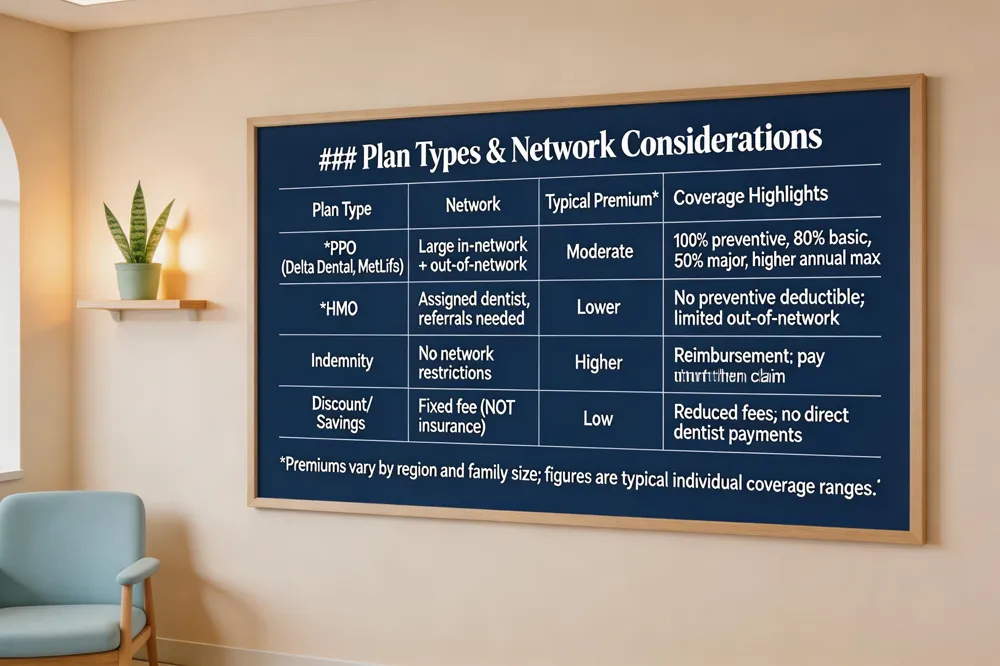 When selecting a dental plan for your family in Somerville, start by understanding the four main plan types—PPO, HMO, indemnity, and discount plans. PPOs such as Delta Dental and MetLife give you the flexibility to see any dentist, but an‑network providers (like Dr. Anthony P. Parrella’s office) lower out‑of‑pocket costs because of negotiated fee schedules. HMO plans require a primary dentist and referrals but often have lower premiums and no deductibles for preventive care. Indemnity plans let you go anywhere and submit claims for reimbursement, while discount (or savings) plans provide reduced fees for a modest annual fee but do not pay the dentist directly.
Delta Dental insurance – The nation’s largest dental‑insurance provider offers PPO and Premier networks, covering preventive services at 100 % and providing low‑cost copays for restorative work. We can verify your Delta Dental benefits and submit claims on your behalf.
MetLife dental insurance – MetLife offers PPO, HMO, and portable “TakeAlong” plans. Preventive care is 100 % in‑network, and negotiated fees typically save 35‑50 % off list prices. Use the MyBenefits portal or call 1‑800‑942‑0854 (PPO) or 1‑800‑880‑1800 (HMO) to confirm coverage.
Individual dental insurance – Purchased directly from insurers like Delta Dental, Cigna, or Blue Cross, individual policies let you choose a network and set your own annual maximum (often $1,000–$2,000). They cover 100 % preventive services and a percentage of basic and major procedures, protecting you from unexpected emergencies.
Supplemental dental insurance – This secondary policy fills gaps left by primary coverage, helping pay for crowns, implants, orthodontics, or cosmetic work. It coordinates with your primary plan so the secondary insurer covers remaining allowed amounts after the primary pays.
What kind of dental insurance should I get? – For most families, a broad‑network PPO (Delta Dental or Cigna) that includes local dentists provides the best mix of flexibility, preventive coverage, and cost savings. If your employer offers a plan, it’s usually the most affordable. Consider a supplemental or dental‑savings plan if you need extra coverage for major work.
Best dental insurance benefits – Look for 100 % preventive coverage, generous discounts on basic procedures (fillings, extractions), reasonable annual maximums ($1,500–$2,000), and coverage for major services (crowns, bridges) and orthodontics when needed. Choosing an in‑network dentist like Dr. Parrella ensures you receive the full value of these benefits.
Specific Coverage Details and Exclusions
What’s Covered vs. Excluded
| Service | Covered? | % Coverage (in‑network) | Notes |
|---|---|---|---|
| Crowns | Yes (major) | ~50 % after deductible | May have 6–12 mo waiting period |
| Fillings | Yes (basic) | ~80 % after deductible | No waiting period for most plans |
| Implants | Usually No | – | Often excluded or limited |
| Orthodontics (adult) | Usually No | – | May require separate rider |
| Cosmetic (whitening, veneers) | No | – | Purely cosmetic, not medically necessary |
| Preventive (cleanings, exams) | Yes | 100 % | No deductible, no waiting period |
| Denture repairs | Yes (major) | ~50 % | Subject to annual max |
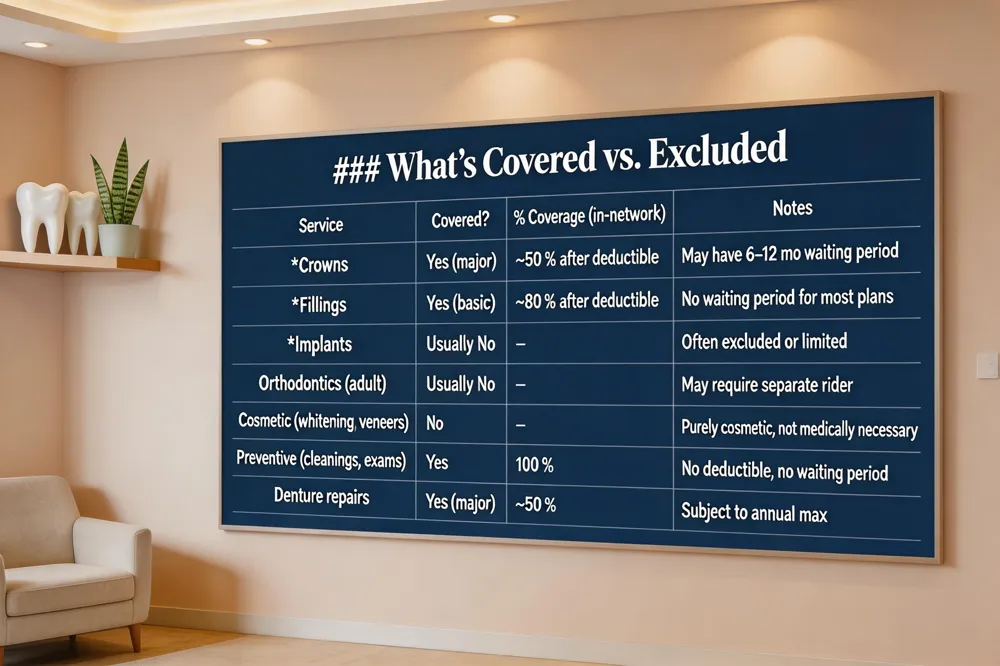 Does MetLife Dental cover crowns? – Yes. Most MetLife plans categorize crowns as a major service. After meeting any deductible and the annual maximum (typically $1,000‑$2,000), MetLife pays about 50 % of the allowed fee for an in‑network dentist, leaving the patient with roughly $350‑$400 for a $1,400 crown. Some plans impose a 6‑12‑month waiting period for major work, so verify your policy and request a pretreatment estimate.
What does dental insurance not cover? – Purely cosmetic procedures (teeth‑whitening, veneers, bonding), most implants and certain prosthetics, adult orthodontics, and services for pre‑existing conditions are generally excluded. Experimental or specialty treatments outside the preventive care, basic services, and major services are also typically denied.
Dental insurance plan categories and limits – Plans usually follow a 100/80/50 structure: 100 % for preventive care (cleanings, exams, X‑rays), 80 % for basic services (fillings, simple extractions), and 50 % for major services (crowns, bridges). Annual maximums range from $1,000 to $2,000 and reset each calendar year; unused benefits do not roll over.
Network vs. out‑of‑network considerations – In‑network dentists have negotiated fee schedules, reducing out‑of‑pocket costs and often eliminating separate deductibles for preventive care. Out‑of‑network providers may be covered at a lower percentage (e.g., 60 % for basics, 30 % for majors) and may require the patient to meet the full deductible before reimbursement. Choosing an in‑network dentist maximizes benefits and minimizes surprise costs.
Practical Tips for Patients and Practices
Practical Tips for Maximizing Benefits
| Tip | Description |
|---|---|
| Pay upfront or arrange post‑EOB | Most offices ask for the estimated patient portion at service; you can negotiate payment plans if needed. |
| Use FSA/HSA funds | Contribute pre‑tax dollars to cover out‑of‑pocket costs; spend by year‑end. |
| Keep detailed documentation | Clinical notes, photos, and correct CDT codes lower claim denials. |
| Schedule early | Book preventive cleanings in Jan‑Mar to use 100 % coverage before the max resets. |
| Split major work | If possible, schedule part of a crown/bridge in one year and the rest the next to use two maximums. |
| Verify network status | Confirm your dentist (e.g., Dr. Parrella) is in‑network to receive full negotiated discounts. |
| Track annual max | Use the insurer’s portal or ask the office for remaining balance after each claim. |
 Understanding how dental insurance works helps families avoid surprise bills and get the most out of their benefits.
Paying upfront vs. post‑EOB billing – Most offices ask patients to cover the estimated portion of a procedure at the time of service, then submit the claim and reconcile any difference after the insurer issues an Explanation of Benefits (EOB). This keeps the practice cash‑flow healthy and prevents unexpected balances. If you cannot pay the estimate, let the office know early; many offer payment plans, financing, or a post‑EOB billing option.
Using Flexible Spending Accounts and Health Savings Accounts – Flexible Spending Accounts and Health Savings Accounts let you set aside pre‑tax dollars for dental care, reducing your net out‑of‑pocket cost. Contributions are deducted before taxes, so you effectively pay less for the same services. Remember to use the funds by the plan’s “use‑it‑or‑lose‑it” deadline, typically the end of the calendar year.
Accurate claim documentation – Detailed clinical notes, intra‑oral photos, and radiographs lower denial rates. Submit all procedures, even those not billable to the patient, and verify that the correct CDT codes are used.
Scheduling and coordination with the office – Book preventive cleanings early in the benefit year to use the 100 % coverage before the annual maximum resets. Plan major work after any waiting period and, if possible, split extensive procedures across two plan years to stay within the $1,000‑$2,000 cap.
If you have dental insurance do you pay upfront? If you have dental insurance, many offices will ask you to pay the estimated portion of your cost at the time of service, then they submit the claim and reconcile any differences after the insurer issues an Explanation of Benefits. This practice helps the practice keep its accounts current and prevents surprise balances later. However, some dentists wait until the claim is processed and bill you only for the amount the insurance does not cover. If you cannot pay the estimate up front, let the office know ahead of time—they often offer payment plans, financing, or a post‑EOB billing option. In short, paying upfront is common but not mandatory; it depends on the practice’s policy and your arrangement with them.
Full coverage dental insurance with no waiting period – Full‑coverage dental insurance that starts paying right away is rare, but several providers do offer plans with no waiting period for preventive care and, in some cases, for basic services as well. Humana’s Complete Dental plan, for example, covers cleanings, exams and fluoride treatments 100 % from day one, and can waive the six‑month basic‑care wait if you’ve had continuous coverage for a year. Aflac’s network dental plans also have no waiting period for preventive services, allowing you to receive routine cleanings and exams without delay. When choosing a plan, look for a low annual maximum and reasonable deductibles to keep out‑of‑pocket costs manageable while still getting comprehensive coverage. Contact our office to review the best no‑waiting‑period options that fit your family’s needs and budget.
Dental insurance no waiting period – Dental insurance plans that waive the waiting period typically cover preventive services—such as exams, cleanings, and fluoride treatments—immediately after enrollment, so you can receive routine care without delay. Humana’s Complete Dental plan and Cigna Dental 1500 both offer 100 % coverage for preventive care with no waiting period, while basic and major services may require a 6‑ to 12‑month waiting period unless you have continuous prior coverage. Aflac’s network dental plans also eliminate waiting periods for preventive care, providing quick access to routine examinations and cleanings. When choosing a plan, verify that your dentist is in‑network and confirm any state‑specific waiting‑period rules for basic or major procedures. Selecting a no‑waiting‑period plan can help you avoid unexpected out‑of‑pocket costs and keep your oral health on track from day one.
Conclusion
By following the six simple tips—use preventive visits fully, spread major work across plan years, take advantage of FSAs or HSAs, submit out‑of‑network claims, address issues early, and choose in‑network providers—you’ll maximize benefits. Review your policy’s deductible, annual maximum, and waiting periods, then call Dr. Parrella’s office to schedule a personalized exam and treatment plan for you.