Why Understanding Dental Insurance Matters
Oral health directly affects your family’s finances – most plans insurance a yearly maximum of $1,000‑$2,000, so any treatment beyond that limit falls to the patient. When you know whether your plan covers preventive care at 100 % and basic services at 70‑80 %, you can schedule cleanings and exams that keep costly restorations from becoming emergencies. A common myth is that dental insurance pays for everything, but most plans exclude cosmetic procedures, orthodontics for adults, and often require a deductible and waiting period before major work is covered. By reviewing your benefit details, confirming in‑network status, and obtaining pre‑authorizations for crowns, bridges, or orthodontic work, you avoid claim denials, reduce out‑of‑pocket surprises, and keep the billing cycle moving smoothly. A clear, well‑understood plan saves time for both the office and your family, turning dental visits into a predictable, affordable part of your health routine.
Step 1‑5: Identify Your Plan, Network, and Coverage Basics
| Plan Type | Network Requirement | Preventive Coverage | Basic Coverage | Major Coverage | Annual Max | Typical Deductible | Co‑payment (per visit) |
|---|---|---|---|---|---|---|---|
| PPO/DPPO | Any dentist (in‑network gives best rates) | 100 % | ≈80 % | ≈50 % | $1,000‑$2,000 | $0‑$150 (basic/major) | Varies (often $20‑$40) |
| HMO | Primary dentist & contracted network | 100 % | ≈80 % | ≈50 % | $1,000‑$2,000 | $0‑$150 | Usually fixed fee |
| Indemnity | No network restriction | 100 % | ≈80 % | ≈50 % | $1,000‑$2,000 | $0‑$150 | Often higher fee |
| Discount | Membership, not insurance | Reduced fee (≈80‑90 % of cost) | Reduced fee (≈70‑80 % of cost) | Reduced fee (≈50‑60 % of cost) | None | None | None |
 Choosing the right dental coverage starts with knowing the type of plan you have. PPO (or DPPO) plans let you see any dentist but give the best rates when you stay in‑network; [HMO](https://content.naic.org/article/consumer-insight-understanding-your-dental-insurance-cavities-cosmetic)** plans require a primary dentist and limit you to a contracted network; [indemnity](https://content.naic.org/article/consumer-insight-understanding-your-dental-insurance-cavities-cosmetic)** plans offer full flexibility but usually involve higher out‑of‑pocket costs; and [discount](https://content.naic.org/article/consumer-insight-understanding-your-dental-insurance-cavities-cosmetic)** plans are not insurance but provide reduced fees for members.
Most plans split services into three categories: [preventive](https://www.uhc.com/dental-vision-supplemental-plans/dental-insurance) (cleanings, exams, X‑rays) at 100 % coverage, [basic](https://www.uhc.com/dental-vision-supplemental-plans/dental-insurance) (fillings, simple extractions) at roughly 80 %, and [major](https://www.uhc.com/dental-vision-supplemental-plans/dental-insurance) (crowns, bridges, implants) at about 50 %. Pay attention to the [annual maximum](https://www.yourdentistryguide.com/insurance/) (often $1,000‑$2,000), the [deductible](https://www.cigna.com/knowledge-center/how-does-dental-insurance-work) you must meet before the insurer pays, any [co‑payment](https://www.cigna.com/knowledge-center/how-does-dental-insurance-work) per visit, and [waiting periods](https://www.cigna.com/knowledge-center/how-does-dental-insurance-work) for non‑preventive care.
When you verify your plan, confirm whether a [primary dentist](https://www.cigna.com/knowledge-center/how-does-dental-insurance-work) is required, check the [in‑network vs. out‑of‑network](https://www.ada.org/resources/practice/dental-insurance/dental-insurance-resources/support-on-dental-insurance-issues) rules, and see if [pre‑authorizations](https://www.ada.org/resources/practice/dental-insurance/dental-insurance-resources/support-on-dental-insurance-issues) are needed for high‑cost procedures. Comparing these details with cash‑pay discounts, financing options, and claim‑submission processes will help you maximize benefits and keep your family’s smiles healthy and affordable.
Step 6‑8: Money Matters – Maximums, Deductibles, Copays, and Waiting Periods
| Service Category | Annual Maximum | Deductible | Coinsurance | Waiting Period |
|---|---|---|---|---|
| Preventive (cleanings, exams, X‑rays) | $1,000‑$2,000 | $0 | 100 % | Immediate |
| Basic (fillings, simple extractions) | $1,000‑$2,000 | $50‑$150 | ≈80 % | 6 months |
| Major (crowns, bridges, implants) | $1,000‑$2,000 | $50‑$150 | ≈50 % | 12 months |
| Orthodontics (separate rider) | $1,500‑$2,500 lifetime | $50‑$150 | 25‑50 % (after deductible) | 12‑24 months |
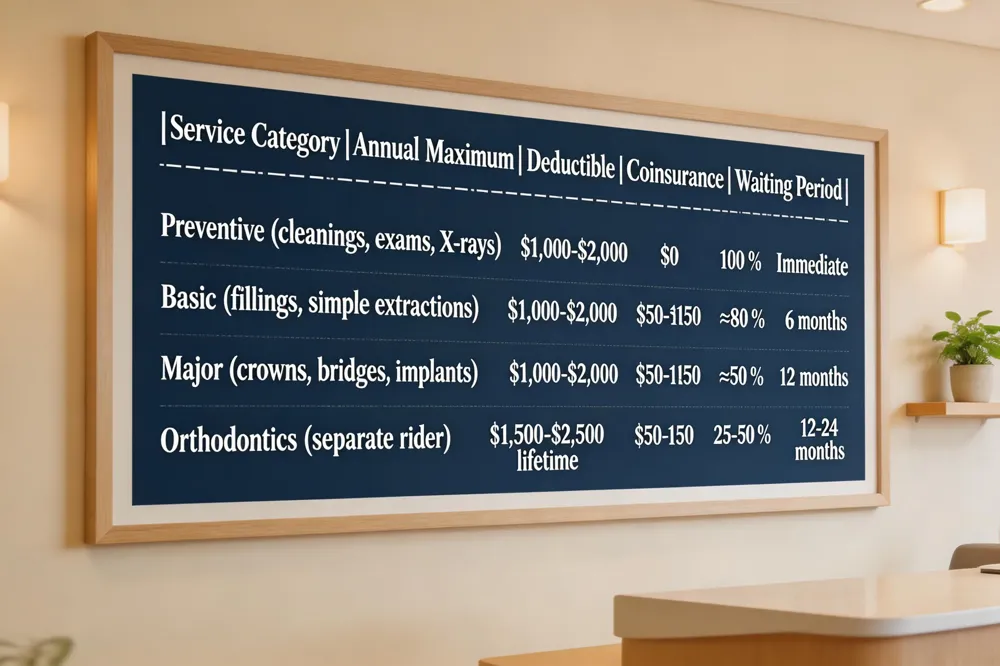 Dental plans set an annual benefit limit of $1,000‑$2,000 that resets each year; most use a “use‑it‑or‑lose‑it” rule. Deductibles range from $0 for preventive care to $50‑$150 for basic and major services and must be met before the insurer shares costs. Copayments are fixed fees; coinsurance is a percentage after the deductible—often 80 % for basic and 50 % for major procedures. Waiting periods are typical: preventive care is immediate, basic services may need 6 months, and major work such as crowns often needs 12 months.
Is a deductible required? Many plans include an annual deductible—often $50‑$150—that applies to basic and major services; preventive care is usually 100 % with no deductible.
Do waiting periods affect coverage? Waiting periods: preventive care starts right away; basic services may require 6 months; major work like crowns often needs 12 months unless you have continuous coverage.
How do you pay for dental insurance? Premiums are paid monthly or annually, usually via payroll deduction, credit card, ACH, or an HSA/FSA for tax‑free payments.
What does dental insurance really cover? Coverage typically: preventive 100 %, basic ~80 %, major ~50 % after deductible; cosmetics and many specialty procedures are excluded.
Step 9‑10: Service‑Specific Coverage – Orthodontics, Implants, and More
| Service | Coverage % (after deductible) | Lifetime Maximum | Typical Waiting Period |
|---|---|---|---|
| Orthodontics (braces) | 25‑50 % | $1,500‑$2,500 | 12‑24 months |
| Implants (surgical placement & crown) | ≈50 % | $1,000‑$2,000 (annual) | 12 months |
| Wisdom‑teeth extraction | ≈50 % | $1,000‑$2,000 (annual) | Immediate for preventiveive majorPremiumCosmetic (whitening, veneers) |
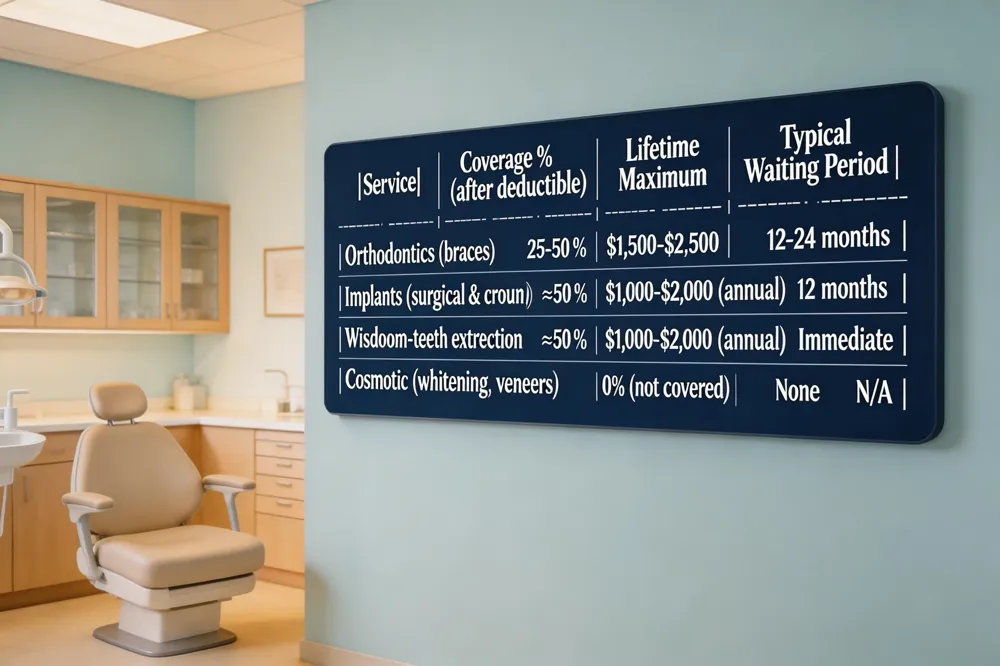 How does dental insurance work for orthodontics? Orthodontic benefits are usually a separate rider or tier‑2 benefit. After you meet the annual deductible and any waiting period (often 12‑24 months), the insurer pays a percentage—typically 25‑50 %—of the total orthodontic cost, up to a lifetime maximum of $1,500‑$2,500. Payments are made in installments throughout treatment, and if you have two policies they coordinate benefits so the combined payout never exceeds the lifetime limit.
Should I get dental insurance for wisdom teeth removal? Wisdom‑teeth extraction can cost $1,200‑$4,175. A plan that covers major procedures (often 50 % after deductible) can halve that out‑of‑pocket expense. Plans also include preventive cleanings that help avoid costly problems later. Review premiums, deductibles, and any waiting period for major work before enrolling to ensure the savings outweigh the ongoing cost.
Full‑coverage dental insurance – what does it mean? A “full‑coverage” plan offers benefits for preventive (100 % covered), basic (high‑percentage), and major services (substantial portion) with an annual maximum often $2,000 or more. While no plan covers every dollar, high‑benefit plans minimize out‑of‑pocket costs for routine and major care.
What does dental insurance not cover? Purely cosmetic procedures—teeth‑whitening, bonding, veneers—are excluded. Adult orthodontics often requires a rider. Some plans limit or exclude implants, certain prosthetics, extensive periodontal surgery, and out‑of‑network care without prior authorization. Pre‑existing conditions are also typically not covered.
Managing Claims, Forms, and In‑Office Billing
| Claim Form | Purpose | Key Fields Required |
|---|---|---|
| ADA Dental Claim Form | Standard dental claim submission | Patient name, DOB, insurance ID, provider taxonomy, CDT codes, fees, diagnosis codes |
| CMS‑1500 | Medical‑type claim for dental services | Patient & provider info, dates of service, procedure codes, charges, ICD‑10 diagnosis |
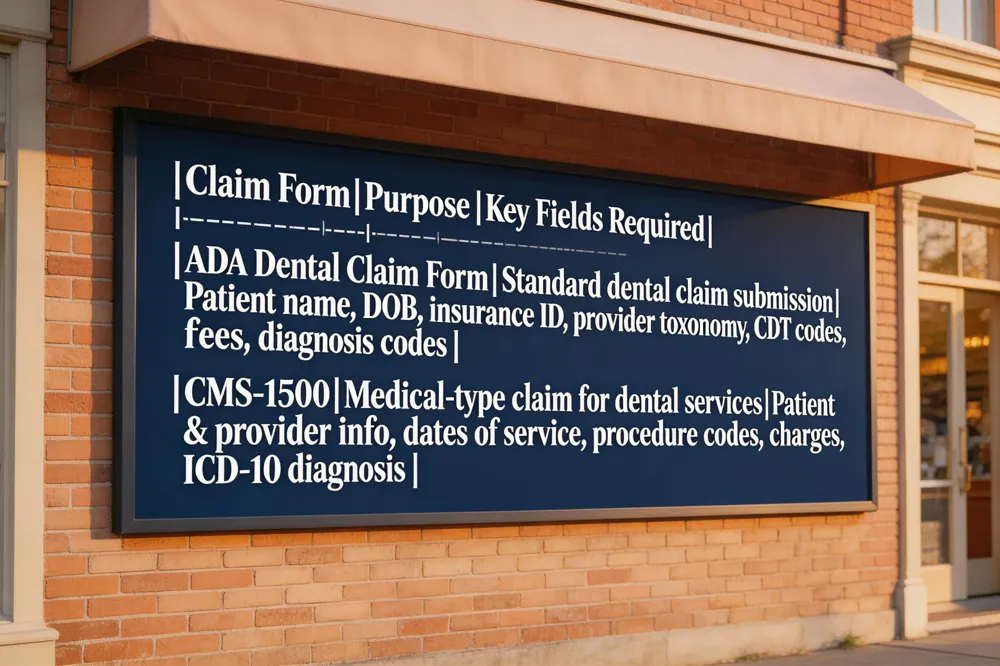 Dental offices use a few standardized claim forms to request payment from insurers. The most common are the ADA Dental Claim Form and the CMS‑1500, which capture the patient’s name, DOB, insurance ID, provider taxonomy code, treatment dates, CDT procedure codes, fees, and up to four diagnosis codes. Accurate completion of these fields is the first step to avoid claim denials.
Typical reasons claims are denied include missing or incorrect CDT codes, omitted diagnosis or tooth‑surface details, mismatched patient demographics, failure to obtain required pre‑authorizations, and exceeding the plan’s annual maximum or waiting‑period limits.
The dental office plays a critical role: after treatment, the insurance specialist reviews the patient’s benefits, enters the procedure data into the practice management system, generates a clean claim, and submits it within one to two business days. If a claim is unpaid after 30 days, the specialist follows up, researches status, resubmits or appeals as needed, and posts the Explanation of Benefits (EOB) to the patient ledger.
A. listed‑ practice can help patients understand their benefits by offering simple brochures, one‑on‑one benefit estimates, and online portals that display claim status and cost calculators, ensuring transparency and confidence in using dental coverage.
Payment Plans, Financing, and Managing Out‑of‑Pocket Costs
| Financing Option | Typical Terms | Interest | Credit Check Required? |
|---|---|---|---|
| In‑house payment plan | 3‑12 months, equal monthly installments | Usually 0 % (promotional) | Often none or soft pull |
| CareCredit (third‑party lender) | 6‑24 months, optional 0 % for 6‑12 months | 0 % promotional, then APR 15‑30 % | Soft pull |
| Sunbit | 6‑18 months, 0 % promotional | 0 % promotional, then APR 15‑25 % | Soft pull |
| HSA/FSA | Pay‑now, tax‑free reimbursement | N/A | N/A |
 Dental care can be affordable when you understand the financing options available. In‑house financing allows the practice to set up a simple payment schedule directly with you, while third‑party lenders such as CareCredit or American First Finance handle the billing and often offer longer terms. Many plans include zero‑interest promotional periods—usually 6 to 12 months—so you can spread the cost of routine cleanings, crowns, implants, or emergency work without extra fees. Eligibility is straightforward: a quick credit check (or a no‑credit‑check option for some lenders) determines the terms, and most patients are approved during the visit. These financing solutions work hand‑in‑hand with insurance reimbursements; the insurer pays its portion first, and the remaining balance is placed on your chosen payment plan, keeping your out‑of‑pocket expense predictable.
Will a dentist let you use a payment plan? Yes—most offices, including Dr. Anthony P. Parrella’s practice in Somerville, offer payment‑plan options with reputable third‑party lenders and promotional zero‑interest rates.
How do payment plans work for the dentist? After a treatment estimate, the office presents in‑house or lender‑based options, you select a term, and make monthly payments; a brief credit check is usually all that’s required.
What are the cons of dental insurance? Premiums, deductibles, copays, annual maximums ($1,000–$2,000), limited coverage for major work, waiting periods, and network restrictions can leave you with sizable out‑of‑pocket costs.
Extra Resources for Low‑Cost and Subsidized Care
| Resource | Eligibility | Key Coverage Highlights |
|---|---|---|
| Health Insurance Marketplace dental plans | Anyone purchasing health insurance during open enrollment | Tiered plans; low‑tier = low premium, higher deductible; high‑tier = lower out‑of‑pocket |
| Medicaid (state‑run) | Low‑income adults (varies by state) | Often limited annual max, focuses on preventive services |
| Discount dental memberships | Open to any member (usually annual fee) | Flat‑rate discounts on all services, no claim filing |
| Dental school clinics | Open to public (often appointment needed) | Procedures performed by supervised students at reduced rates |
| Non‑profit assistance programs | Unserved or low‑income families | Free or low‑cost emergency extractions, cleanings, limited restorations |
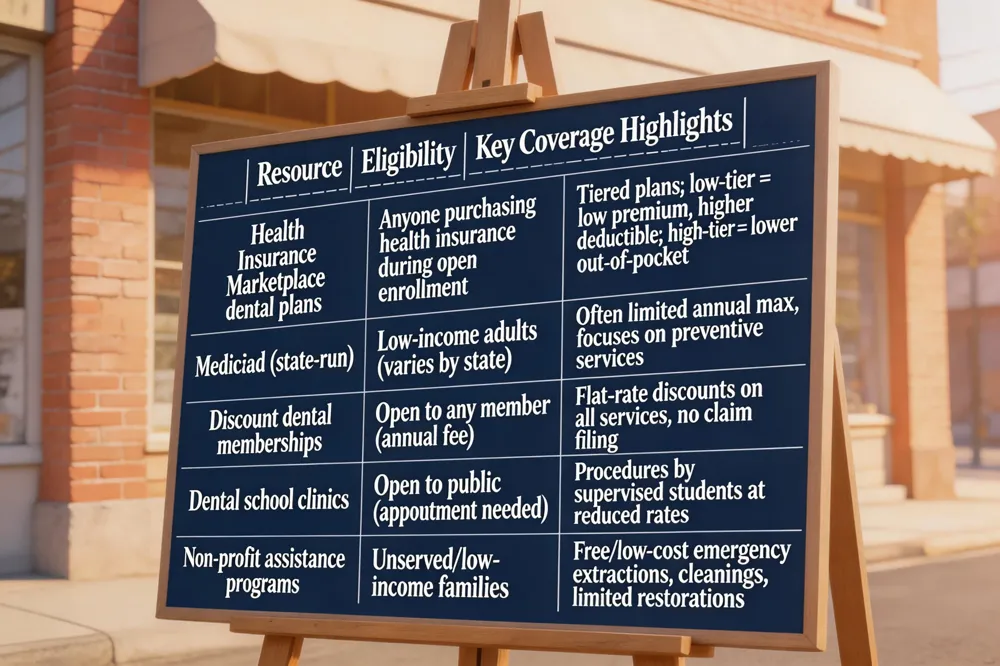 For families seeking affordable coverage, the Health Insurance Marketplace offers adult dental plans that can be added to a health plan during open enrollment. These plans come in high‑ and low‑coverage tiers; the low‑tier options have modest monthly premiums but higher deductibles and copayments, while the high‑tier plans provide lower out‑of‑pocket costs for preventive, basic, and major services.
Medicaid and state‑run public programs remain the backbone of low‑cost dental care for eligible adults. While Medicaid universally covers children, many states now extend limited adult benefits—often with a modest annual maximum and a focus on preventive services. Checking your state’s Medicaid portal can reveal whether you qualify for these benefits, and some states also run community dental clinics that accept Medicaid directly.
Discount dental memberships and school‑based clinics provide another avenue for reduced fees. Membership plans, such as those offered by large carriers or local dental societies, give participating patients a set discount on services without the paperwork of traditional insurance. Dental schools frequently operate teaching clinics where supervised students perform procedures at a fraction of the market rate, making crowns, fillings, and cleanings more affordable.
Finally, non‑profit assistance programs—often run by charitable foundations, local health departments, or community organizations—can supply free or low‑cost oral‑health services to underserved families. These programs may cover emergency extractions, preventive cleanings, or even limited restorative work, helping bridge the gap when insurance or personal finances fall short.
Putting It All Together – Your Checklist Before the Next Visit
| Step | Action |
|---|---|
| 1 | Confirm plan type (PPO, HMO, indemnity, discount) and that the office is in‑network |
| 2 | Check remaining annual maximum and deductible balance |
| 3 | Verify waiting‑period status for any planned major or orthodontic work |
| 4 | Ask about pre‑authorizations and ensure the office will submit a clean claim with correct CDT codes |
| 5 | Discuss payment‑plan or financing options if out‑of‑pocket costs exceed coverage |
 Before you schedule your next dental appointment, run through this quick, patient‑focused checklist to keep your insurance and finances on track:
-
Confirm plan type and network status – Know whether you have a PPO, DHMO, indemnity, or discount plan and verify that the practice is in‑network. In‑network dentists enjoy pre‑negotiated fees and higher reimbursement (e.g., 100 % preventive, 80 % basic, 50 % major).
-
Verify annual maximum and deductible remaining – Check how much of your $1,000‑$2,000 yearly benefit is left and what deductible (often $50‑$150) you still owe before the insurer contributes.
-
Check waiting‑period status for planned procedures – Major work such as crowns, bridges, or orthodontics usually requires a 6‑12‑month waiting period; preventive care is covered immediately.
-
Ask about pre‑authorizations and claim submission – For high‑cost or specialty services, obtain prior approval and confirm the office will submit a clean claim with the correct CDT codes and any required images.
-
Explore payment‑plan or financing options – If your out‑of‑pocket balance exceeds coverage, discuss in‑office financing, CareCredit, Sunbit, or use an FSA/HSA for tax‑free payments.
Running through these steps helps avoid surprise bills and keeps your smile healthy and affordable.
Conclusion – Empowered Choices for a Healthy Smile
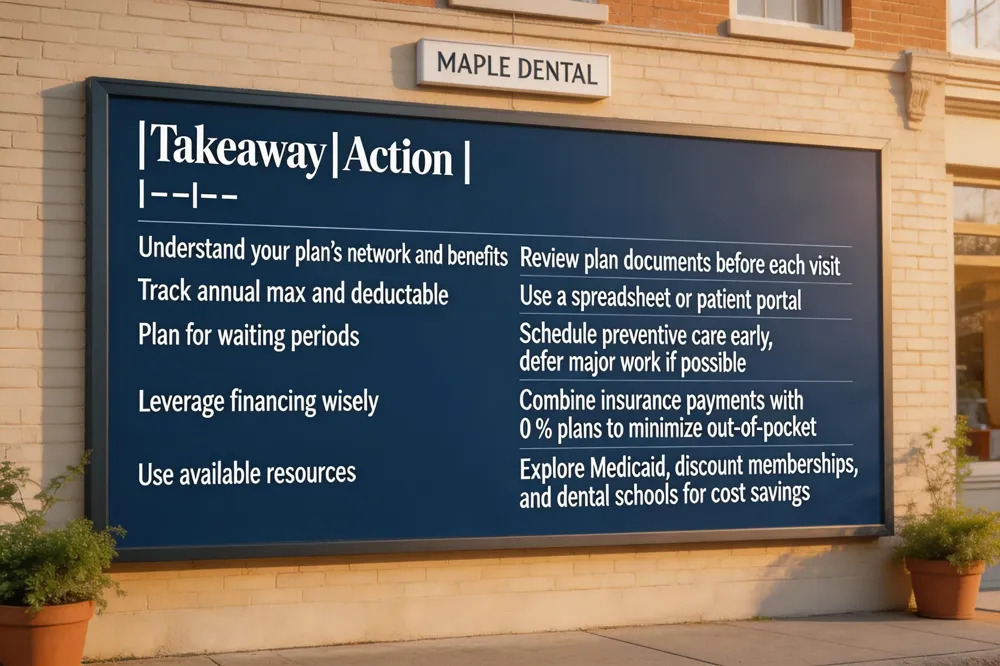
| Takeaway | Action |
|---|---|
| Understand your plan’s network and benefits | Review plan documents before each visit |
| Track annual max and deductible | Use a spreadsheet or patient portal |
| Plan for waiting periods | Schedule preventive care early, defer major work if possible |
| Leverage financing wisely | Combine insurance payments with 0 % plans to minimize out‑of‑pocket |
| Use available resources | Explore Medicaid, discount memberships, and dental schools for cost savings |
 We've walked through the eight essential steps—from Intake call gathers patient demographics and insurance details and accurate claim entry to timely Follow‑up on unpaid claims after 30 days, including resubmission and appeals and Patient pays remaining balance, completing billing cycle—showing how each stage protects your coverage and speeds care. Our team pledges honest billing and will answer every question. Call today to schedule a benefits review and keep your smile healthy.
Your Path to Confident Dental Care
Before your next appointment, review the eight‑step dental billing cycle—from intake call to final patient payment—to avoid surprises. Dr. Parrella’s staff will explain your plan’s deductible, annual maximum, and coverage categories, ensuring you understand out‑of‑pocket costs. We also offer CareCredit, Sunbit, and flexible in‑office payment plans for any remaining balance.