Introduction
Welcome to our guide on dental cost‑sharing, designed for families in Somerville and readers everywhere. This article explains the purpose of demystifying dental copays, deductibles, coinsurance, and annual maximums so you can make informed choices about preventive, restorative, and cosmetic care. Understanding these financial tools matters because they directly affect out‑of‑pocket expenses, help you avoid unexpected bills, and enable budgeting for routine cleanings and major procedures. By breaking down how each component works—whether you have a copay‑only plan like Ameritas DentalSelect or a coinsurance‑based PPO—you’ll see how coverage starts, what you pay at each visit, and how to maximize benefits. This guide empowers you to navigate dental insurance confidently, protect oral health, and plan for a brighter smile for families.
Understanding Core Dental Cost Terms
| Term | Definition | Example |
|---|---|---|
| Deductible | Fixed dollar amount you must pay each benefit period before insurance pays. | $50 per year before any coverage. |
| Copay | Set amount you pay at the time of service; does not count toward deductible but counts toward out‑of‑pocket max. | $30 for a routine cleaning. |
| Coinsurance | Percentage of the allowed charge you pay after the deductible is met. | 20 % of a $300 filling = $60 after deductible. |
| Out‑of‑pocket maximum | The most you will pay in a year; after reaching it, insurer pays 100 %. | $1,500 annual max. |
| Preventive care exemption | Services (exams, cleanings, fluoride) covered at 100 % without meeting deductible. | Routine cleaning covered fully. |
 What does the term “deductible” refer to in dental insurance? In dental insurance, a deductible is the fixed dollar amount you must pay out of pocket each benefit period—usually a calendar year—before your plan begins to cover any portion of a service. Once met, the insurer shares the remaining cost according to the plan’s coinsurance rate. Preventive care (exams, cleanings, fluoride) is often exempt, being covered at 100 % without first meeting the deductible.
What is the typical Delta Dental copay for a cleaning? Most Delta Dental plans require a modest copayment of roughly $15 to $30 for a routine prophylaxis. Higher‑tier plans may cover the cleaning completely, resulting in a $0 copay. The exact amount depends on plan type and network status.
What does a $30 copay mean? A $30 copay is a set amount you pay out‑of‑pocket for a specific dental service, such as a routine cleaning. You hand the $30 to the dentist at the appointment; the insurance covers the remaining allowable fee. The copay does not count toward the deductible but applies toward your annual out‑of‑pocket maximum. After reaching that maximum, the insurer pays 100 % of any additional covered care.
Typical Copay Amounts for Common Procedures
| Procedure | Typical Delta Dental Copay (range) | Notes |
|---|---|---|
| Routine cleaning (prophylaxis) | $15 – $30 (some high‑tier plans $0) | Preventive; often exempt from deductible. |
| Simple extraction (non‑surgical) | $30 – $60 | In‑network discounted fee applied. |
| Surgical extraction (impacted/wisdom) | $75 – $150 | Higher due to complexity. |
| Crown | $40 – $80 | Varies by material and network status. |
| Implant | $300 (fixed) | Example of a major treatment copay. |
| Prescription medication | $10 – $35 (generic vs brand) | Tiered; does not count toward deductible. |
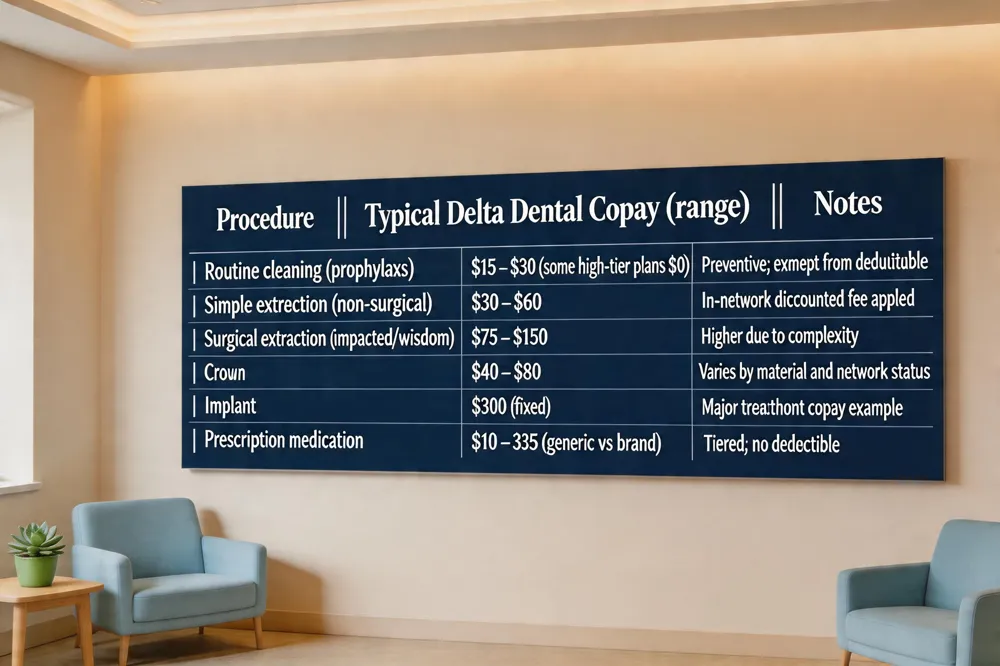 When you walk into Dr. Anthony P. Parrella’s office in Somerville, MA, one of the first questions many families ask is how much they will owe at the time of service. A dental copay is a fixed dollar amount you pay up‑front, regardless of the total bill, and it is not counted toward your deductible, though it does apply toward your annual out‑of‑pocket maximum.
What is the typical Delta Dental copay for an extraction? Delta Dental generally requires a copay of roughly $30 to $60 for a simple (non‑surgical) tooth extraction. For a surgical extraction—such as an impacted tooth or wisdom tooth—the typical copay rises to about $75 to $150. These amounts can vary depending on the specific Delta Dental plan tier you have and the geographic region where the dentist practices. In‑network providers usually apply a discounted fee, so the copay is calculated on that reduced amount. If you are out‑of‑network, the copay is a percentage of the dentist’s full, non‑discounted charge.
What does a $300 copay mean? A $300 copay is a fixed amount you owe the dentist at the time you receive a specific service. Unlike a percentage‑based coinsurance, the copay does not change based on the total cost of the procedure—it’s a set dollar figure defined by your dental plan. For example, if your insurance lists a $300 copay for a major treatment such as an implant, you would pay that $300 up front, and the insurer would cover the remaining approved charges. Copays are usually not applied toward your deductible, but they do count toward your annual out‑of‑pocket maximum.
What is a copay for a prescription? A prescription copay is a fixed amount you pay out‑of‑pocket each time you fill a medication, rather than a percentage of the drug’s price. The exact dollar amount is set by your health‑plan benefit design and is usually printed on your insurance card or listed in the plan’s formulary. Copays often differ by drug tier—generic drugs might be $10, while brand‑name drugs could be $35 or more—and some plans even waive the copay for certain preventive prescriptions. Because the copay is a flat fee, it does not count toward meeting your deductible, although it does contribute to your annual out‑of‑pocket maximum.
How Copays Work in Practice
| Aspect | Details |
|---|---|
| Payment timing | Collected at the dentist’s office before treatment begins. |
| In‑network vs out‑of‑network | In‑network: only the scheduled copay. Out‑of‑network: copay + difference between charge and allowed amount. |
| Out‑of‑pocket maximum | Copays count toward the annual limit; after reaching it, insurer pays 100 %. |
| Preventive care | Often $0 copay; covered at 100 % without meeting deductible. |
| Example | $20 copay for cleaning, $40 for crown; both applied at visit. |
 Dental copays are a fixed dollar amount you pay at the time of service, not a percentage of the bill. For example, many plans set a $20 copay for a routine cleaning and $40 for a crown. The amount is predetermined by your insurance and may be waived for preventive care.
Payment timing and location – The copay is collected right at the dentist’s office, usually before the provider begins treatment. It is a direct payment to Dr. Parrella’s team, separate from any later insurance claim.
In‑network vs out‑of‑network – When you see a contracted (in‑network) dentist, you only pay the scheduled copay; the plan covers the rest up to the contracted rate. With a non‑contracted dentist, you pay the copay plus any difference between the dentist’s charge and the plan’s allowed amount.
Copays and out‑of‑pocket maximums – Most dental plans count copays toward your annual out‑of‑pocket limit (or the plan’s annual maximum). Once that limit is reached, the insurer pays 100 % of additional covered services.
Do dentists charge a copay? – Yes. Most plans require a copay for office visits and routine procedures. The exact amount varies by plan and service, so ask our staff or review your benefit summary for specifics.
Choosing Between Copay and Coinsurance Plans
| Factor | Copay‑style Plan | Coinsurance‑style Plan |
|---|---|---|
| Predictability | Fixed amount per visit → easy budgeting. | Payment varies with service cost. |
| Frequent low‑cost visits | Usually cheaper (e.g., $15‑$30 cleanings). | May end up paying more if many visits. |
| High‑cost procedures (crowns, implants) | Fixed copay may be high (e.g., $300). | Low percentage after deductible can be cheaper. |
| Deductible | Often lower or zero; you start paying copays immediately. | Higher deductible before coinsurance kicks in. |
| Out‑of‑pocket max | Copays count toward max; coinsurance also counts after deductible. | Same max, but timing differs. |
 When you compare dental copay and coinsurance options, the key is to match the cost‑sharing structure to your personal oral‑health needs and budgeting style.
Higher deductible vs higher coinsurance – If you anticipate frequent visits—cleanings, fillings, or orthodontic work—a lower deductible with a higher coinsurance rate is usually more cost‑effective because you start sharing costs early and the percentage you pay applies to each service. A plan with a high deductible and low coinsurance can be cheaper for patients who rarely need dental care, since you’ll pay the full deductible only when treatment occurs. Consider your typical annual dental expenses and whether you prefer predictable out‑of‑pocket amounts (coinsurance) or a low upfront yearly commitment (deductible).
Coinsurance vs copay – which is better for a patient? Copays are easy to budget; the amount is fixed and due at the visit. Coinsurance can be more economical for high‑cost procedures—crowns, bridges, implants—when the percentage you owe is low after meeting the deductible. If you have frequent, low‑cost services, the predictable copay often results in lower overall spending.
What does dental coinsurance mean? It is the percentage of the allowed charge you pay after the deductible is met. For a $300 filling with a $100 deductible and 80 % coverage, you would pay $100 + 20 % ($40) = $140.
What is coinsurance versus a deductible? The deductible is the fixed amount you must pay each year before the plan shares costs. Once met, coinsurance kicks in— you pay a percentage of the remaining charge while the insurer pays the rest. Coinsurance does not count toward the deductible.
Avoiding Claim Denials and Getting the Most from Your Plan
| Common Denial Reason | How to Avoid |
|---|---|
| Non‑covered service (e.g., cosmetic) | Verify coverage in benefit summary before treatment. |
| Out‑of‑date member info | Keep personal and contact info current in insurer portal. |
| Missing pre‑authorization | Request and obtain pre‑auth for required procedures. |
| Out‑of‑network provider | Confirm network status or get a network‑equivalent quote. |
| Coding errors | Ensure dentist uses correct CDT codes and submits accurate documentation. |
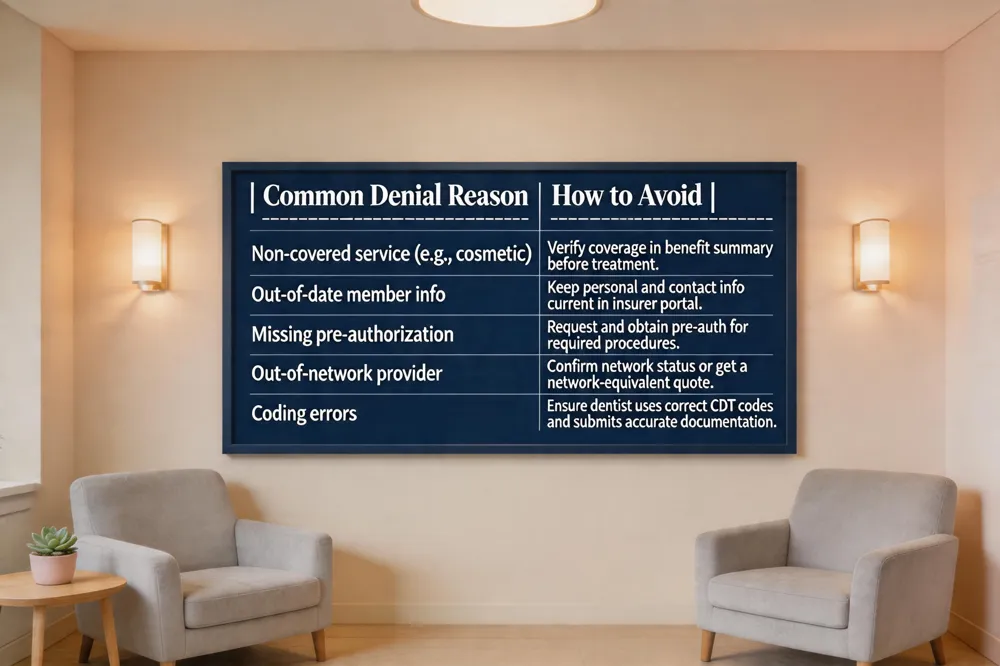 When a dental claim comes back as denied, the most frequent cause is a non‑covered charge—services such as cosmetic procedures that aren’t included in the patient’s benefit plan (often flagged with denial code PR‑96). Out‑of‑date member information or missing pre‑authorizations can also trigger denials, but they rank behind coverage gaps.
A MetLife copay dental plan works on a fixed‑fee model: members pay a set amount at the time of service (e.g., $25 for a routine cleaning) while MetLife covers the rest based on the contracted rate. Copays do not count toward the deductible and give predictable out‑of‑pocket costs for preventive care.
To verify claims before treatment, use the insurer’s online portal or call the provider‑services line, confirm the procedure is covered, check any required pre‑authorizations, and make sure the dentist is in‑network. This quick check prevents surprise bills and maximizes your plan’s benefits.
Conclusion
When you walk into Dr. Parrella’s office, understanding the four key cost‑sharing terms—copays, coinsurance, deductibles, and the out‑of‑pocket maximum—helps you predict what you’ll pay each visit. A copay is a fixed fee (e.g., $20 for a cleaning) that you pay at the appointment, while coinsurance is a percentage of the allowed charge after any deductible is met. Deductibles are the amount you must spend before the plan starts sharing costs, and the OOP max caps your total annual out‑of‑pocket spending. Review your plan’s schedule of benefits, ask our staff any questions, and we’ll work together to keep your smile healthy and your budget comfortable.