Welcome to Your Gum‑Health Journey
Good gum health is the foundation of a healthy smile and a key player in overall well‑being. Inflammation in the gums can signal or even contribute to systemic conditions such as heart disease, diabetes and respiratory problems, making early detection essential. This guide walks you through the stages of gum disease, common risk factors, warning signs, and evidence‑based prevention and treatment options—from daily brushing and flossing to professional cleanings, scaling and root planing, and, when needed, surgical therapies. At Dr. Parrella’s practice, our compassionate team provides personalized risk‑assessment, gentle deep‑cleanings, modern antimicrobial adjuncts, and ongoing maintenance visits, ensuring each family member receives the education and care needed to keep gums healthy every day for life.
Understanding Gum Disease: Types, Causes, and Risk Factors
Key Facts on Types, Causes, and Risk Factors
| Type | Description | Main Risk Factors | Prevention Tips |
|---|---|---|---|
| Gingivitis | Early, reversible inflammation of gums caused by plaque buildup. | Poor oral hygiene, smoking, hormonal changes, high‑sugar diet, genetics. | Brush twice daily, floss daily, use antimicrobial mouthwash, limit sugary foods, quit tobacco, professional cleaning twice a year. |
| Periodontitis | Advanced infection destroying bone & connective tissue, leading to deep pockets & possible tooth loss. | Untreated gingivitis, uncontrolled diabetes, smoking, genetics, certain medications. | Same as gingivitis plus regular dental check‑ups, targeted scaling & root planing, control systemic conditions. |
 Gum disease falls into two main types. Gingivitis is the early, reversible inflammation of the gums caused by plaque buildup; it appears as red, swollen, bleeding gums and can be resolved with proper oral hygiene and professional cleaning. If untreated, gingivitis can progress to periodontitis, an advanced infection that destroys the supporting bone and connective tissue, creating deep pockets, gum recession, and possible tooth loss. The disease starts when dental plaque—a sticky bacterial film—hardens into tartar, allowing harmful microbes to invade the gum line. Key risk factors include poor oral hygiene, smoking, uncontrolled diabetes, hormonal changes, certain medications, genetics, and a high‑sugar diet. Prevention is straightforward: brush twice daily with fluoride toothpaste, floss or use interdental cleaners every day, rinse with an antimicrobial mouthwash, limit sugary foods, quit tobacco, and schedule professional cleanings at least twice a year. Early detection through regular check‑ups can halt progression, keep your smile healthy, and protect overall well‑being.
Recognizing the Signs: Symptoms and Stages of Periodontal Disease
Symptoms & Stages Overview
| Stage | Pocket Depth (mm) | Clinical Features | Typical Treatment |
|---|---|---|---|
| Gingivitis | 1‑3 (healthy) | Red, swollen, bleeding gums; no bone loss. | Improved oral hygiene, professional cleaning. |
| Mild Periodontitis | 1‑2 | Shallow pockets, slight attachment loss. | Scaling & root planing, diligent home care. |
| Moderate Periodontitis | 3‑4 | Deeper pockets, 3‑4 mm bone loss, recession, possible pus. | SRP + adjunctive antimicrobials, possible flap surgery. |
| Advanced (Stage IV) Periodontitis | >7 | Severe attachment loss, extensive bone loss, tooth mobility. | Intensive SRP, regenerative surgery, host‑modulation antibiotics. |
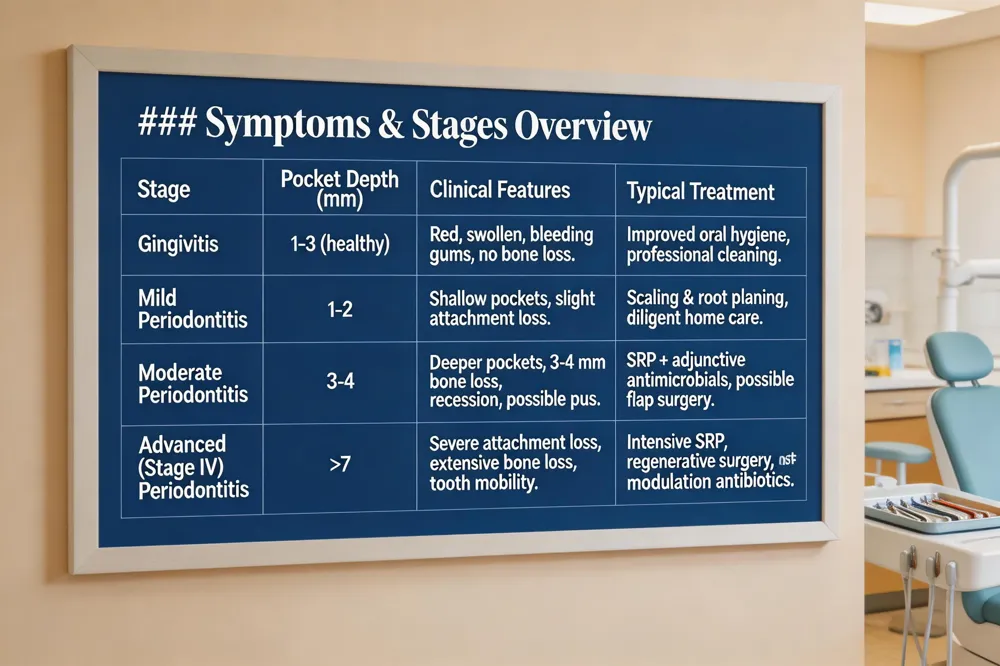 Periodontal disease often starts with red, swollen, tender gums that bleed when you brush or floss. Persistent bad breath, a foul taste, and occasional pus are early warnings. If the condition advances, gums may recede, forming deep pockets that harbor bacteria, and teeth can become loose or shift. Advanced periodontitis can cause painful chewing, swelling, and eventual tooth loss.
The disease follows a clear progression. Gingivitis is the first, reversible stage—gums are inflamed but no bone loss occurs. Continued plaque below the gum line leads to mild periodontitis (shallow pockets, 1‑2 mm attachment loss). It then moves to moderate periodontitis (deeper pockets, 3‑4 mm bone loss, possible recession and pus). The final stage, advanced (stage IV) periodontitis, shows attachment loss >7 mm, substantial bone loss, tooth mobility, and risk of loss.
While stage 3 disease cannot fully regrow lost tissue, professional deep cleaning, meticulous home care, and, when needed, regenerative surgery can halt progression and restore some support. Untreated gum disease does not kill directly, but it raises the risk of heart disease, stroke, diabetes complications, and other serious systemic conditions. Early detection and consistent care protect both your smile and your overall health.
Daily Defense: Home Care Strategies to Keep Gums Healthy
Daily Home‑Care Checklist
| Practice | Frequency | Recommended Products / Details |
|---|---|---|
| Brushing | Twice daily | Soft‑bristled brush, fluoride toothpaste (stannous fluoride or essential‑oil blends). |
| Flossing / Interdental cleaning | Every day | Dental floss, interdental brushes, or water‑flosser. |
| Antimicrobial mouthwash | Twice daily (20 mL, 30‑60 s) | Essential‑oil rinse, 0.12 % chlorhexidine, or cetyl‑pyridinium chloride. |
| Toothpaste for gum health | Twice daily | Products like Colgate Total, Crest Pro‑Health Advanced, Oral‑B Pro‑Expert Gum Protection. |
| Dietary support | Ongoing | Vitamin C‑rich foods, antioxidants, limit sugary snacks, stay hydrated. |
| Lifestyle | Ongoing | Quit smoking, manage diabetes, regular stress reduction. |
 Keeping gums healthy starts with consistent, gentle brushing—use a soft‑bristled brush, fluoride toothpaste, and circular motions that sweep the gum line twice a day. Follow each brushing session with daily flossing or interdental cleaning to disrupt plaque that a brush can’t reach, and finish with an antimicrobial mouthwash (e.g., essential‑oil or 0.12% chlorhexidine for extra protection.
Choosing a gum‑health toothpaste matters: products containing stannous fluoride, essential‑oil blends or clinically proven antibacterial agents (Colgate Total, Crest Pro‑Health Advanced, Oral‑B Pro‑Expert Gum Protection) lower plaque and bleeding while strengthening enamel.
Mouthwash selection should focus on proven agents—essential oils, chlorhexidine, cetylpyridinium chloride, or zinc chloride—used twice daily for 20 mL, 30‑60 seconds.
Natural reversal strategies include a diet rich in vitamin C and antioxidants, quitting tobacco, limiting sugary foods, and adjuncts such as green‑tea rinses, turmeric paste, or diluted hydrogen peroxide to soothe inflammation.
While diligent home care can halt early gum disease, scaling and root planing and regular dental visits are essential for true cure and long‑term protection.
Professional Diagnosis, Planning, and Targeted Antibiotic Use
Clinical & Radiographic Diagnostic Tools
| Diagnostic Tool | What It Assesses | Typical Findings | Follow‑up Action |
|---|---|---|---|
| Visual inspection & probing | Gum inflammation, pocket depth, bleeding on probing. | Healthy: 1‑3 mm; >4 mm indicates periodontitis. | Document, progression plan, possibly SRP. |
| Bite‑wing / periapical X‑rayays Bone levels, furcation involvement. | Bone loss ≥30 % = periodontitis. | Stage disease, plan surgical vs non‑surgical therapy. | |
| Microbial testing | Specific bacterial profile. | Presence of P. gingivalis, T. forcardis, etc. | Targeted antibiotic regimen (amoxicillin + metronidazole, etc.). |
| Risk‑factor assessment | Smoking, diabetes, meds, genetics. | Identified high‑risk patients. | Tailor maintenance recall (3‑6 mo) and adjunctive therapies. |
 A thorough clinical exam starts with a visual inspection of the gums, probing pocket depths (1‑3 mm is healthy, >4 mm suggests periodontitis) and checking for bleeding on probing. Radiographic assessment with bite‑wing or periapical X‑rays reveals bone loss and helps stage the disease. Together these findings guide a personalized treatment‑plan PDF that outlines risk factors (smoking, diabetes, medications), the sequence of therapy—initial scaling and root planing, oral‑hygiene instruction, re‑evaluation, any needed surgery—and a maintenance recall schedule (every 3‑6 months). Evidence‑based antibiotic use is reserved for aggressive or refractory cases. The preferred regimen is amoxicillin + metronidazole; clindamycin replaces amoxicillin in penicillin‑allergic patients, and low‑dose doxycycline (20 mg twice daily) can be added for host‑modulation. Antibiotics complement, not replace, mechanical debridement and should be chosen based on microbial testing and clinical judgment.
Effective Treatments: From Deep Cleanings to Advanced Surgical Options
Treatment Options by Pocket Depth
| Pocket Depth | Primary Treatment | Adjunctive Measures | Expected Outcome |
|---|---|---|---|
| ≤5 mm | Scaling & root planing (SRP) | Antimicrobial mouthwash, oral hygiene reinforcement. | Pocket reduction, inflammation control. |
| 6‑8 mm | SRP + local antibiotics or systemic antibiotics | Chlorhexidine rinse, amoxicillin + metronidazole if needed. | Improved pocket depth, stabilization. |
| 9‑10 mm | SRP → minimally invasive flap surgery | Guided tissue regeneration (GTR), bone grafts, local antibiotics. | Regained attachment, bone fill. |
| >10 mm | SRP → advanced flap (osseous) surgery | LANAP, extensive bone grafting, membranes, systemic doxycycline. | Significant regeneration, reduced mobility. |
 Scaling and root planing (SRP) is the first line of defense for deep pockets. For 8 mm pockets, SRP combined with antimicrobial rinses or systemic antibiotics is performed; if depth remains >5 mm, minimally invasive flap surgery and regenerative options (guided tissue regeneration, bone grafting or soft‑tissue grafts) are considered. A 9 mm pocket requires intensive SRP across quadrants, often with locally delivered antibiotics; persistent depth leads to flap‑reduction surgery, possibly with guided tissue regeneration or bone grafting to restore attachment. Ten‑millimeter pockets represent advanced disease—after thorough SRP and local antibiotics, flap (osseous) surgery is needed, with adjunctive bone grafts, membranes, or LANAP to rebuild bone and connective tissue. For overall advanced periodontal disease, deep SRP is followed by surgical pocket reduction, regenerative bone or tissue grafts, and targeted antimicrobial therapy. Long‑term maintenance every 3‑4 months, diligent home care, and risk‑factor control (quit smoking, manage diabetes) are essential to keep results stable.
Managing Costs and Maintaining Long‑Term Oral Health
Cost Overview & Financial Strategies
| Service | Approx. Cost (USD) | Insurance Coverage | Financing / Discount Options |
|---|---|---|---|
| Prophylaxis cleaning | $50‑$75 | 50‑80 % after deductible (preventive) | Discount cards, bundled family plans. |
| Scaling & root planing (per quadrant) | $250‑$500 | 50‑70 % (nonsurgical) | In‑office financing, payment plans. |
| Pocket‑reduction flap surgery (per site) | $600‑$3,000 | Limited, often 20‑30 % | Low‑interest loans, care‑of‑care discounts. |
| Bone graft / GTR (per site) | $800‑$4,500 | Varies, may be considered surgical | Insurance pre‑approval, sliding‑scale fees. |
| Extensive flap surgery (per quadrant) | $7,000‑$9,000 | Minimal coverage | Financing programs, health‑savings accounts. |
| Maintenance recall (3‑6 mo) | $100‑$200 per visit | Preventive portion covered | Membership plans, prepaid packages. |
 Typical fees vary by treatment level. A routine prophylaxis cleaning costs about $50‑$75, while a deep cleaning (scaling and root planing is $250‑$500 per quadrant, often $1,000‑$2,000 for the full mouth. Surgical options such as pocket‑reduction surgery, gum grafts, or bone regeneration range from $600‑$3,000 per site, and extensive flap surgery can exceed $7,000‑$9,000 per quadrant. Dental insurance usually covers a portion of preventive and nonsurgical periodontal care—often 50‑80 % after deductibles—while surgery may have limited benefits. Many offices, including Dr. Parrella’s, offer financing plans, discount programs, and will coordinate with your insurer to lower out‑of‑pocket costs. Regular maintenance visits every 3‑6 months are essential; they catch disease early, reduce the need for costly surgery, and keep your gums healthy for life.
Your Path to Healthy Gums Starts Today
Keeping your gums healthy is within reach when you combine daily habits with care. Brush twice a day with fluoride toothpaste, floss or use interdental cleaners each day, and rinse with an antimicrobial mouthwash to curb plaque. Quit tobacco, eat a diet rich in vitamins C and D, and manage diabetes or stress to lower risk. Regular check‑ups every six months let us remove tartar, measure pocket depths, and catch early signs of gum disease before they progress. If you notice bleeding, swelling, or persistent bad breath, schedule an appointment with Dr. Parrella promptly. Together we’ll create a plan, reinforce care, and provide scaling, root planing, or surgery when needed. Stay proactive—your smile thanks you.