Welcome to Your Six‑Month Checkup
At the start of your six‑month visit, the front desk confirms contact and insurance details, then the hygienist updates your medical history and takes any needed X‑rays. A thorough cleaning removes plaque and tartar, followed by polishing and a fluoride or sealant application. The dentist then performs a visual exam, checks gum pockets, screens for oral cancer, and reviews the radiographs. Regular six‑month check‑ups catch decay, gum disease, and other problems early, keeping treatment simple and affordable. Our practice prioritizes comfort—music, blankets, and a pause signal are available—while fostering a friendly, family‑focused atmosphere that builds lasting trust for you today.
Step‑by‑Step Journey Through the Chair
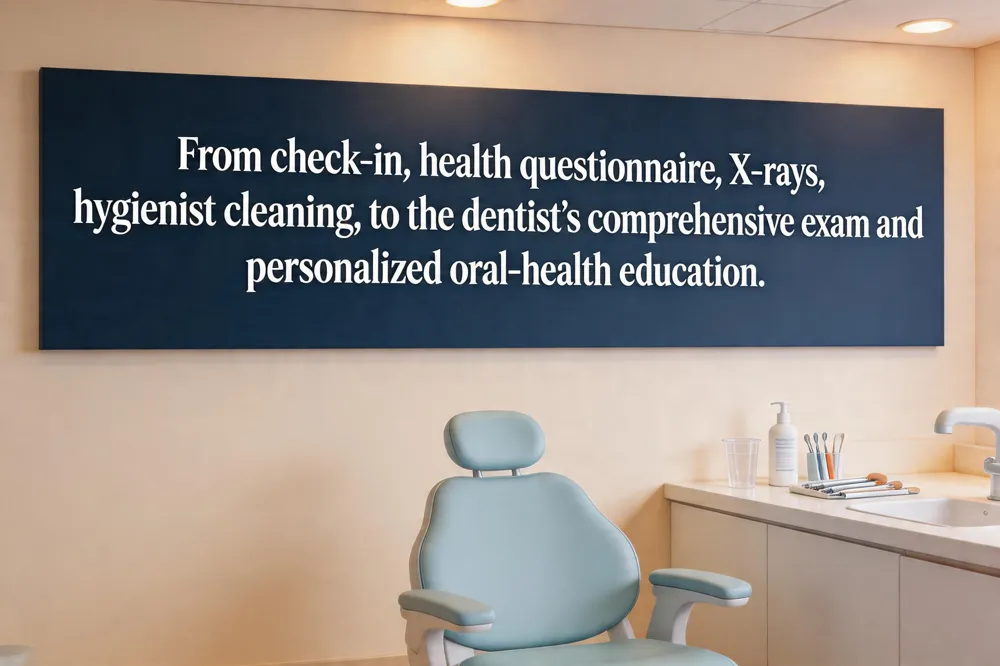 A six‑month dental appointment begins the you step through the door and the front‑desk staff checks you in, verifies your insurance, and confirms that your contact information is up‑to‑date. You may be asked to complete a brief health questionnaire that captures any changes in medical conditions or medications since your last visit.
Next, the dental hygienist updates your dental history and, if it’s been more than two years, takes low‑dose intra‑oral X‑rays to reveal hidden decay or bone loss. Using an ultrasonic scaler and hand tools, the hygienist removes plaque and tartar (calculus) from every tooth surface and below the gum line, then polishes the enamel and flosses between the teeth to leave a smooth, clean finish.
After cleaning, the dentist conducts a comprehensive oral exam: a visual inspection of teeth, gums, tongue, palate, throat, and neck; probing of gum pockets with a periodontal probe; and a thorough oral‑cancer screen. Any X‑ray images are reviewed, and the dentist discusses findings, treatment options, and preventive measures such as fluoride or sealants.
Patient education is a core part of the visit. You’ll receive personalized brushing, flossing, and dietary advice, and the team will schedule your next six‑month recall—usually a complimentary toothbrush and payment options are reviewed at checkout.
What should I expect at a dental checkup?
When you arrive, staff will check you in and may ask you to update your medical and dental history before the hygienist takes any X‑rays and performs a professional cleaning. After the cleaning, the dentist examines every surface of your teeth, gums, bite, and soft tissues, reviews any X‑ray images, and discusses your oral‑health habits and any needed treatment. Finally, you schedule the next visit to keep your smile healthy.
Dental check up meaning
A dental check‑up is a scheduled visit where a professional evaluates the health of your teeth, gums, and oral tissues, removes plaque and tartar, may take X‑rays, and discusses prevention or treatment. Routine check‑ups catch problems early and help avoid costly procedures.
Does a dental exam include a cleaning?
The exam and cleaning are separate procedures performed in the same appointment. The hygienist cleans first; the dentist then conducts a comprehensive examination. While they are often bundled for convenience, the exam itself is only the evaluation, not the cleaning.
Types of Dental Examinations Explained
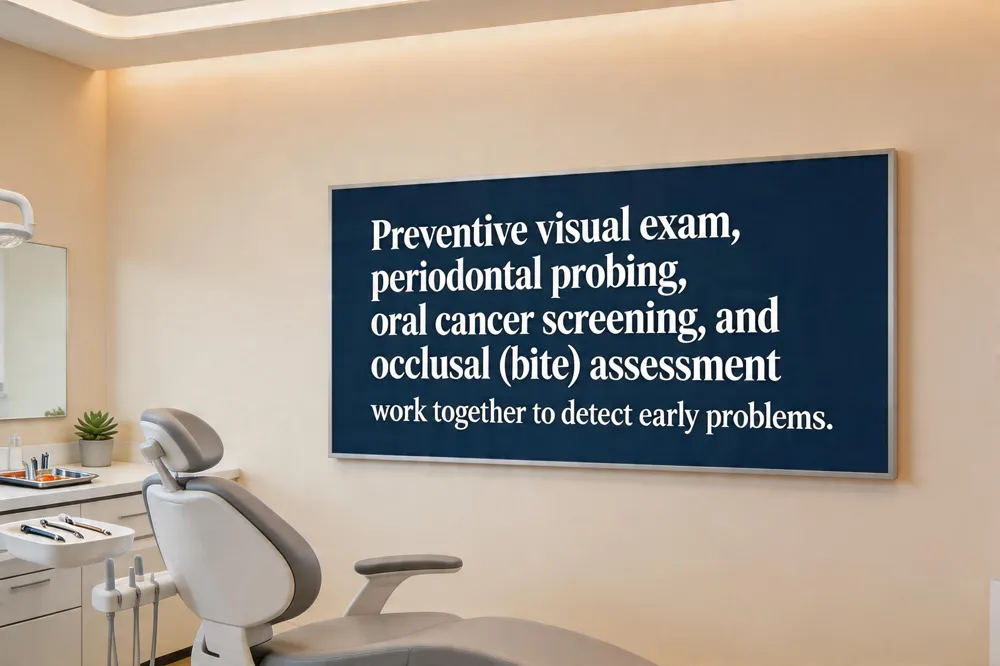 A routine preventive visual exam and cleaning is the foundation of six‑month dental care. The dentist inspects every tooth, gum line, and soft tissue with a bright light and mirror while the hygienist removes plaque, tartar, and stains through scaling and polishing. Bite‑wing or periapical X‑rays may be taken to reveal hidden decay or bone loss.
Periodontal probing and gum‑health assessment follow the cleaning. Using a calibrated periodontal probe, the clinician measures pocket depths around each tooth; shallow pockets indicate healthy gums, while deeper pockets signal early periodontal disease. The hygienist records bleeding, recession, and inflammation for the dentist’s review.
Oral cancer screening techniques involve a visual and tactile examination of the lips, tongue, floor of the mouth, throat, and neck. The dentist looks for discoloration, lesions, or abnormal tissue and may use adjunctive tools such as a VELscope for enhanced illumination.
Occlusal (bite) assessment evaluates how the upper and lower teeth meet. The dentist checks for uneven wear, misalignment, or grinding that can affect chewing comfort and jaw health, and may take impressions or digital scans if orthodontic or restorative work is needed.
These four examination types—preventive visual exam, Periodontal probing, Oral cancer screening, and occlusal assessment—work together to detect problems early, guide personalized treatment, and keep families in Somerville smiling confidently.
Cost Considerations Without Insurance
 When you walk into a Somerville dental office for a routine six‑month check‑up, the out‑of‑pocket price can vary, but most families can expect a clear, predictable range.
Typical price ranges for exams and cleanings in Somerville – A basic oral exam without X‑rays usually costs $75–$150. Adding a professional cleaning (scaling and polishing) brings the total to $150–$250, while a comprehensive visit that includes diagnostic X‑rays can run $250–$350.
National average and factors that affect cost – Across the United States, the average fee for an exam plus cleaning is about $203, with a broad swing from $50 to $350 depending on the practice’s location, the dentist’s experience, and any supplemental services (fluoride varnish, sealants, deep‑cleaning). Office overhead, technology (digital versus film X‑rays), and the complexity of the case all influence the final bill.
Additional fees for X‑rays and specialty services – If full‑mouth or bite‑wing X‑rays are needed, expect an extra $100–$250. Specialty procedures such as a fluoride treatment, nightguard, or periodontal probing may add $20–$80 each.
Financing options and insurance coverage – Even without insurance, most Somerville offices—including Dr. Parrella’s practice—offer flexible payment plans and CareCredit financing to spread costs over several months. Patients with dental insurance typically see 80‑100 % coverage for preventive services, reducing the out‑of‑pocket amount to $0‑$50.
Quick answers to common questions
- Dental check‑up cost without insurance: $75–$150 for an exam; $150–$250 when X‑rays are included.
- Annual dental check‑up cost: $150–$250 for the exam plus $80–$120 for cleaning, totaling $230–$370.
- Dental check‑up and cleaning cost: $200–$300 for the combined service, reflecting the Massachusetts average of $178 for a full preventive visit.
For the most accurate estimate, call Dr. Parrella’s office at (617) 625‑3022 and discuss the specific services you’ll need. Transparent pricing and personalized financing help keep your family’s smile healthy without breaking the bank.
Beyond Cleaning: Treatment Planning and Prevention
 A six‑month visit is more than a cleaning; it’s a chance to tailor preventive care.
Fluoride varnish and sealants – After the hygienist finishes scaling and polishing, the dentist may apply a thin fluoride varnish or sealant to vulnerable surfaces. Fluoride strengthens enamel and can cut new cavities by up to 30 % in high‑risk patients, while sealants protect the pits and fissures of molars from hidden decay.
Oral cancer and lymphoma detection – The comprehensive exam includes a visual and tactile screen of the lips, tongue, floor of the mouth, and neck. By feeling for painless swollen lymph nodes or persistent sores, the dentist can spot early signs of oral cancer or even systemic lymphoma, prompting timely referral for medical evaluation.
Polishing necessity and patient preferences – Polishing smooths the enamel after scaling, reducing future plaque adhesion. It is not mandatory; patients who prefer a more natural feel or whose gums are sensitive may opt out, and the hygienist will respect that choice.
3‑3‑3 rule for post‑procedure pain control – For mild inflammation or discomfort, the guideline recommends taking three 200 mg ibuprofen tablets every three hours, not exceeding three days, unless a dentist advises otherwise.
Dental check‑up vs. cleaning – A check‑up is the dentist’s thorough oral examination (including X‑rays, gum probing, and cancer screening), while a cleaning (prophylaxis) performed by the hygienist removes plaque and tartar and finishes with polishing. Both are scheduled together every six months to catch problems early and keep smiles healthy.
First‑Time Visits and Ongoing Care
 When you book a six‑month check‑up after a long gap, the office will first confirm or update your health and insurance details at the front desk. Many practices now let you complete the intake paperwork online before you arrive, which speeds up check‑in and gives the team a clear picture of any new medical conditions or medications.
Digital X‑ray technology and comfort measures – After the paperwork, a dental hygienist will take digital X‑rays if they are needed. The images are captured in seconds, use virtually no radiation, and are viewed instantly on a screen, allowing the dentist to spot hidden decay or bone loss. Comfort is a priority: patients may be offered a lead apron, headphones for music, or a blanket, and the hygienist will use ultrasonic scalers that feel gentle yet effective.
Personalized oral‑hygiene instructions – Once the cleaning (scaling and polishing) is complete, the dentist reviews the X‑ray and visual findings, then provides tailored advice on brushing technique, flossing, diet, and optional products such as fluoride varnish or antimicrobial rinses. This education is designed to keep your mouth healthy between visits.
Scheduling and community‑focused care – Before you leave, the staff will schedule your next six‑month recall and discuss any financial options, often offering a complimentary toothbrush. Practices like Dr. Anthony P. Parrella’s in Somerville emphasize a family‑run atmosphere, making it easy for local families to stay on track with preventive care.
What to expect at first dentist appointment in years – Arrive, update your records, complete a brief questionnaire, receive quick digital X‑rays, enjoy a thorough cleaning, undergo a comprehensive exam (including oral cancer screening), and leave with a personalized treatment plan and home‑care recommendations.
Dental check‑up meaning – A dental check‑up is a scheduled preventive visit where a hygienist cleans your teeth and may take X‑rays, while the dentist examines teeth, gums, bite, and soft tissues for decay, disease, or other abnormalities, and provides education and a treatment plan to keep your smile healthy.
Your Next Six‑Month Reminder
Keeping your dental check‑up every six months is a proven way to catch decay, gum disease, or oral cancer early, saving you time, discomfort, and costly treatment later. At Dr. Anthony P. Parrella’s Somerville practice, the team tailors each visit to your unique health history, using digital X‑rays, personalized periodontal probing, and a thorough oral‑cancer screen. After a gentle ultrasonic cleaning and polishing, they give you custom brushing and flossing tips, and, if needed, a fluoride varnish or sealant. Call us today or book online to secure your next appointment—your smile and overall health deserve the best preventive care.